
Wing Commander (Ret’d) John McFadden
Business Development Director, CRFS

Jaimie Brzezinski
Head of Content, CRFS
As the battlefield is now flooded with electronic devices and autonomous platforms, superiority no longer means better armed troops deployed by high-end platforms that cost billions and take decades to procure.
In the old order, electronic warfare (EW) was carried out by specialist units and exquisite platforms. In the new order, Russian GPS jamming, spoofing and Starlink degradation in Ukraine have demonstrated that EW is now the price of entry for any modern peer conflict.
The UK must address its core structural weaknesses: reduced survivability, unoptimised targeting cycles and slow procurement. One way is to deploy autonomous mass on the tactical edge: tactical sensors with a strategic impact.
Achieving a high-low mix
In a future conflict scenario, the RAF cannot afford to risk crewed, exquisite platforms, like the RC-135W Rivet Joint, due to reduced survivability in or close to threat zones. The 2022 ‘released missile’ incident over the Black Sea was a stark reminder of the risk in deploying them close to hostile airspace.
Continuing to gather electronic intelligence successfully will depend on an electromagnetic ‘high-low mix:’ combining existing sophistication with scalable technologies that provide mass and persistence where costly assets cannot be deployed. One example is the TEKEVER AR5 integrated with an RFeye Node (SIGINT payload).
Integrating sensors into unmanned systems (UxS) — following Ukraine’s model of using inexpensive ISR drones that take advantage of rapid software iteration — can close capability gaps. Operating at the tactical edge, these lower-cost systems can be fielded at scale, providing interoperable SIGINT, ESM and ISR capability.
By sharing electromagnetic data with UK and coalition Battlefield Management Systems, these platforms can enhance military situational awareness, helping different units, systems and partners achieve objectives.
Decisive military advantage will not come from expensive, long-term programmes, but from those who can sense first, decide quickly and adapt continuously
Integrate autonomous sensing systems into resilient kill webs
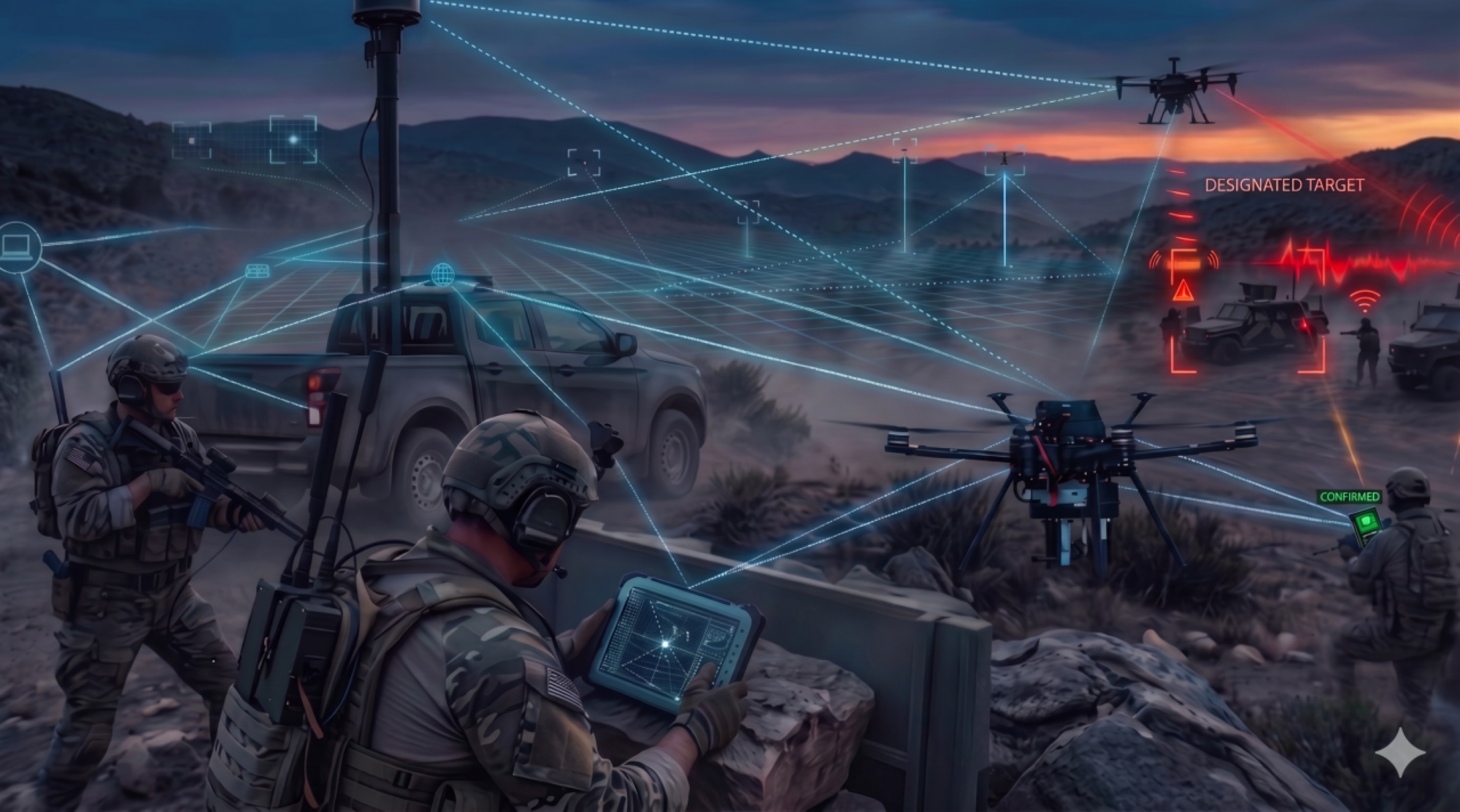
The electrification of the battlefield has accelerated the tempo and lethality of forces by shortening the Sensor-to-Shooter Cycle. Military doctrine has replaced rigid, linear kill chains with dynamic, decentralised networks known as ‘kill webs,’ which enable rapid, flexible targeting and delivery of effects.
Based on lessons from Ukraine, where the kill zone is reported to extend 10–20km, with a further 20–30km grey zone, the UK’s ‘Digital Targeting Web’ intends to connect sensors, deciders and effectors over extensive areas. The battlefield needs to be connected by netted sensors that constantly send real-time data back to command and control.
Deploying sensors on attritable, unmanned and autonomous systems means the kill web can be resilient and flexible, even when high-value and human assets are excluded from contested zones. This enables commanders to preserve decision advantage and better understand the extended battlespace.
This structure embraces mosaic warfighting in which systems function as individual pieces, creating unique mosaics of military force.
A procurement model for the speed of need
Identifying and integrating capability faster has become a determinant of combat power. Rigid, slow-cycle platform programmes are incompatible with high-tempo, unmanned, autonomy-enabled warfare. Operational advantage now depends on the speed of need — the ability for militaries and their industry partners to rapidly integrate, iterate and scale capabilities.
Desired operational effects must be defined first, with architectures, then backwards engineered with industry to deliver outcomes. Hence, the industry is no longer a vendor, but an operational teammate inside the capability generation loop.
COTS sensors payloads on UxS will accelerate development and procurement cycles to achieve the 24-6-6 cadence required for peer conflict. Within 24 hours, software can be updated to adapt to adversary waveform changes and output new metadata formats, ensuring continuous interoperability — EW reprogramming is the decisive factor in electromagnetic dominant environments.
Within six weeks, hardware can be spirally developed to ensure EW sensors can keep pace with emerging threats. And within six months, an entirely new capability can be developed. Static assets become continuously adaptable systems.
Conclusion
Decisive military advantage will not come from expensive, long-term programmes, but from those who can sense first, decide quickly and adapt continuously. Deploying autonomous mass on the tactical edge allows commanders to do that. Tactical, low-cost sensors can have a huge strategic impact.
