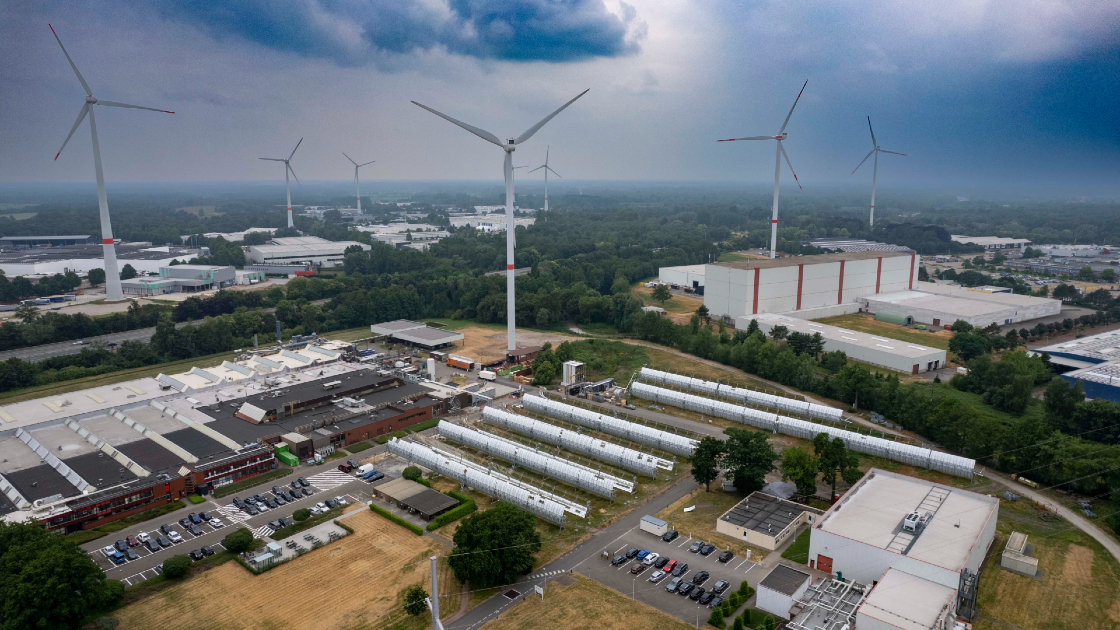

For Avery Dennison, sustainability means more than just setting targets and publishing reports. It’s also about wind energy, solar thermal energy, waste reduction, alternative raw materials and new adhesive technologies. The site in Turnhout demonstrates how a global sustainability strategy only truly becomes real when it is converted into investments, production processes and products.
Anne Verhaert
Sustainability Director
Avery Dennison

Jan Willekens
Technology Director Europe
Avery Dennison
The company operates in the fields of materials science and digital identification. It develops products including labelling and packaging materials, industrial tapes, graphic applications and RFID solutions. In Turnhout, Avery Dennison manufactures high-performance tapes for demanding industrial applications. Anne Verhaert, Sustainability Director, and Jan Willekens, Technology Director Europe, explain how sustainability is put into practice within the company.
What are your targets for 2030?
Anne Verhaert: ‘Our 2030 targets build on the 2025 sustainability goals that we set in 2015 and have since been achieved. So it’s not a break with the past, but a further acceleration of the path we’re already on. The bar has been raised, though. For our Scope 1 and Scope 2 emissions, we are aiming for a 70% reduction by 2030 versus 2015. A target has now also been set for Scope 3 emissions, i.e. emissions across the wider value chain: a 30% reduction compared with 2018. These emission targets have been approved by the Science Based Targets Initiative and are therefore in line with the Paris Agreement. In addition, we aim to source 100% certified paper, ensure that at least 95% of our waste is landfill-free and recycle 80% of our waste by 2030.’
How can sustainability become more than just a separate programme?
Anne Verhaert: ‘There are various incentives. We do, of course, have our corporate sustainability targets, but economic realities also play a part. Energy efficiency and waste reduction aren’t just good for the environment: they also make good business sense. In addition, there are legislative requirements and customers who are increasingly calling for more sustainable solutions. At the same time, sustainability alone isn’t usually enough of an argument. Customers are looking for products that make progress in that area, but that also perform just as well. That’s why sustainability must be embedded in innovation, investment and day-to-day decisions.’
What exactly is happening at the site in Turnhout?
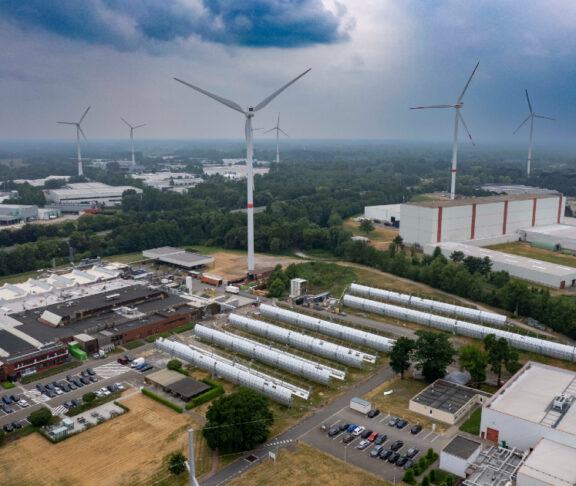
Jan Willekens: ‘Turnhout took steps towards renewable energy at an early stage. We launched the wind turbine project initiative back in 2007, long before corporate sustainability targets or the Paris Agreement were even on the agenda. The turbine finally started up l in 2017. The produced electricity is fed directly into our internal network, making the project both sustainable and economically viable. Today, our biggest challenge lies not only in electricy, but above all in heating. Our production processes use drying ovens for adhesive curing and release coatings. These assets still run predominantly on natural gas, so we’ve invested in concentrated solar thermal energy with thermal storage. This means that heat generated during the day can be used later in the production process.’
Does this mean Turnhout is playing a leading role within the group?
Jan Willekens: ‘Without wanting to sound biased: yes. Turnhout has played a pioneering role within Avery Dennison in Europe and even worldwide. That’s partly down to the site’s DNA. We’ve been working on energy efficiency here since the 1990s, for example through relighting projects, heat recovery and more efficient processes. Besides, Performance Tapes are specialised products for industrial applications, which requires an entrepreneurial spirit and technical expertise. At the same time, the energy transition remains complex. Everyone is talking about electrification, but the switch from relatively cheap natural gas to more expensive electricity is difficult to justify on economic grounds. In Belgium, this is less widely supported than in some neighbouring countries, making the path towards 2030, and certainly towards net zero in 2050, all the more challenging.’
How is the product portfolio evolving in line with the sustainability strategy?
Anne Verhaert: ‘Sustainability doesn’t stop with energy. The product portfolio is also changing. In the case of labels, for example, it means products that enable the recycling of packaging. For performance tapes, we are focusing primarily on products with a lower carbon footprint. Solvent-based tapes remain essential for demanding applications, such as those involving temperatures above 200 degrees Celsius or high shear forces. We manufacture these too as sustainably as possible, for example by reusing heat generated from the combustion of solvents. At the same time, we’ve invested heavily in solvent-free technologies. We’ve developed two patented solutions: UV hot-melt adhesives and advanced water-based acrylics. For certain applications, they deliver the same or even better performance than traditional solvent-based products, with a significantly lower carbon footprint. That’s the crux of the matter: sustainability only works when it goes hand in hand with performance. Customers don’t want to have to choose between technical reliability and a lower environmental impact.’
