

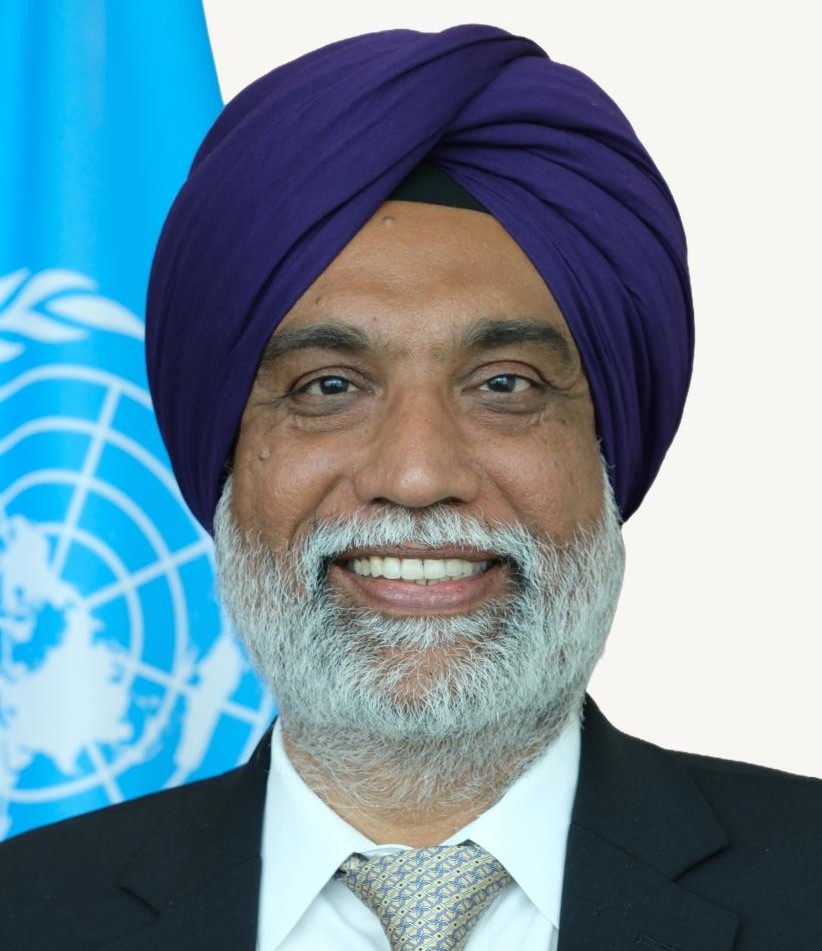
Amandeep Singh Gill
United Nations Under-Secretary-General and Special Envoy for Digital and Emerging Technologies
For most countries, the AI debate has happened elsewhere, influenced by a few governments and companies with the resources to shape it. The science, safety frameworks and rules: all developed largely without the countries that will be most affected.
That’s the problem the UN is trying to address, and the structure of its response matters as much as the ambition.
The Global Digital Compact, adopted by the General Assembly in September 2024, established two linked mechanisms. The first is an Independent International Scientific Panel on Artificial Intelligence and the second is a Global Dialogue on AI Governance, both created by a UN General Assembly resolution in August 2025.
The Panel produces the evidence, and the Dialogue is where that evidence meets political deliberation, with every country present, not just those that built the technology.
AI won’t reach its potential for health, climate and development
if the countries that need it most remain recipients of decisions made elsewhere.
The Panel
The Panel’s 40 members come from across disciplines, regions and development levels, serving in their personal capacity. Co-chaired by Canada’s Yoshua Bengio and the Philippines’ Maria Ressa, it publishes an annual policy-relevant report on AI’s opportunities, risks and impacts. The mandate is bounded by design: not to tell states what to do, but to establish what the science shows.
The Dialogue
The Dialogue is where states decide what to do. Convened annually, with the first convening July 6-7 in Geneva and in May 2027 in New York, it brings together governments, industry, civil society and the scientific community to work through topics such as safety, human rights and capacity-building. It produces a Co-Chairs’ summary, not binding decisions.
This openness is deliberate. The AI debate swings between miraculous productivity gains and existential risk dominated by a few wealthy countries. Neither helps a health ministry in Senegal weighing whether an AI diagnostic tool is safe, nor a labour ministry in Vietnam working out what automation means for its workforce.
AI won’t reach its potential for health, climate and development if the countries that need it most remain recipients of decisions made elsewhere. The Panel and Dialogue don’t make guarantees, but they’re a serious attempt to ensure that when rules get written, the whole world is present.
