Business & Industry



Sharon Gee
SVP, Product AI, Commerce
The customer journey is no longer just three to five steps. In the era of agentic commerce, it has two: intent and transaction. We see a golden opportunity.
People can easily ask their favourite AI agent to surface products, find one and increasingly are even able to buy it without ever leaving the chat. This is great for the consumer. But, considering 33% of ecommerce leaders say they haven’t started optimising product pages for AI, and none of them claims total readiness, it’s also a clear challenge for businesses.1
The commerce compression era
With 37% of today’s shoppers starting their product journeys with AI, rather than Google, this becomes a discoverability problem for brands.2
As e-commerce businesses across the board lack product pages ready for agentic AI, we see two main challenges arising.
Businesses are invisible to agentic AI
Agentic AI doesn’t need a business’s permission to fulfil a search query, only its data. If it can’t access the relevant attributes that give context on a brand’s catalogue, it’s not recommending them to anyone.
With many businesses having hundreds or thousands of products across numerous channels, manually managing data is nearly impossible.
Efficiency is a moving target
Teams are shrinking, financial goals are greater and multichannel expansion is necessary to stay competitive. Organisations are spread dangerously thin.
Automation can help with several e-commerce tasks, from inventory management to product feed enrichment and beyond. But, once again, it all comes down to data.
Finding inspiration in retail
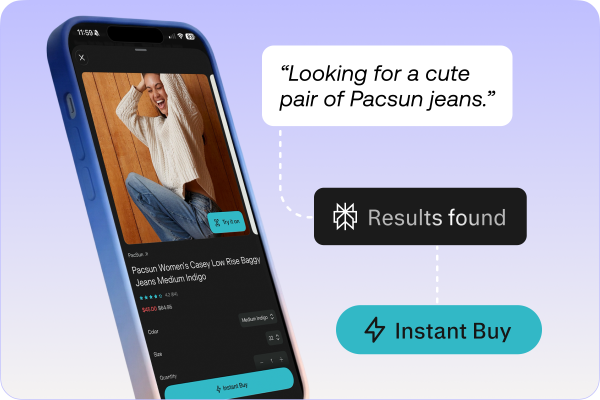
PacSun is a great example of how businesses can adapt. An iconic retail brand with more than 300 physical stores, PacSun has a large inventory to manage both on and offline.
Using Agentic Instant Checkout on AI platforms with Perplexity, CoPilot PayPal and Commerce, PacSun can pull data from its e-commerce platform and enrich and scale product data with feed management. From there, shoppers can use a platforms Perplexity, CoPilot and Google AI surfaces via UCP to find and purchase their products without leaving the interface.
The best part? Any business reading this can make a similar pivot.
Teams are shrinking, financial goals are greater and multichannel expansion is necessary to stay competitive.
Unified systems are a must
Where the omnichannel approach prioritises delivering a cohesive messaging and shopping experience across channels, unified commerce connects all tools and data on the backend, resulting in comprehensive data.
Complete data solves the invisibility problem, and it helps businesses overcome shrinking resources. When a business unifies its e-commerce platform with inventory management, payment processing, etc, a plethora of automation becomes available.
Unified systems also pave the way for improved analytics. When you’ve got a limited budget or tightening margins, every action needs to count. What better way to make sure you hit the mark than leveraging real-time analytics?
Agentic-friendly checkout is next
With systems unified and product feed management up and running, the next step for businesses is making sure agentic agents can process a user’s purchase. This can only happen if the right checkout experience is provided.
Businesses that want to win in this age of commerce need the data for agents to find them, and a modern, agentic surface-compatible checkout that closes the circle.
[1] BigCommerce. (2026). Is ecommerce ready for AI? 15 ecommerce leaders weigh in on AI in 2026. https://tinyurl.com/3k6z3skj.
[2] Eight Oh Two. 2026 AI & search behavior study. https://tinyurl.com/4uv5j235.