


Dr Angela Needle
Director of Strategy at Cadent
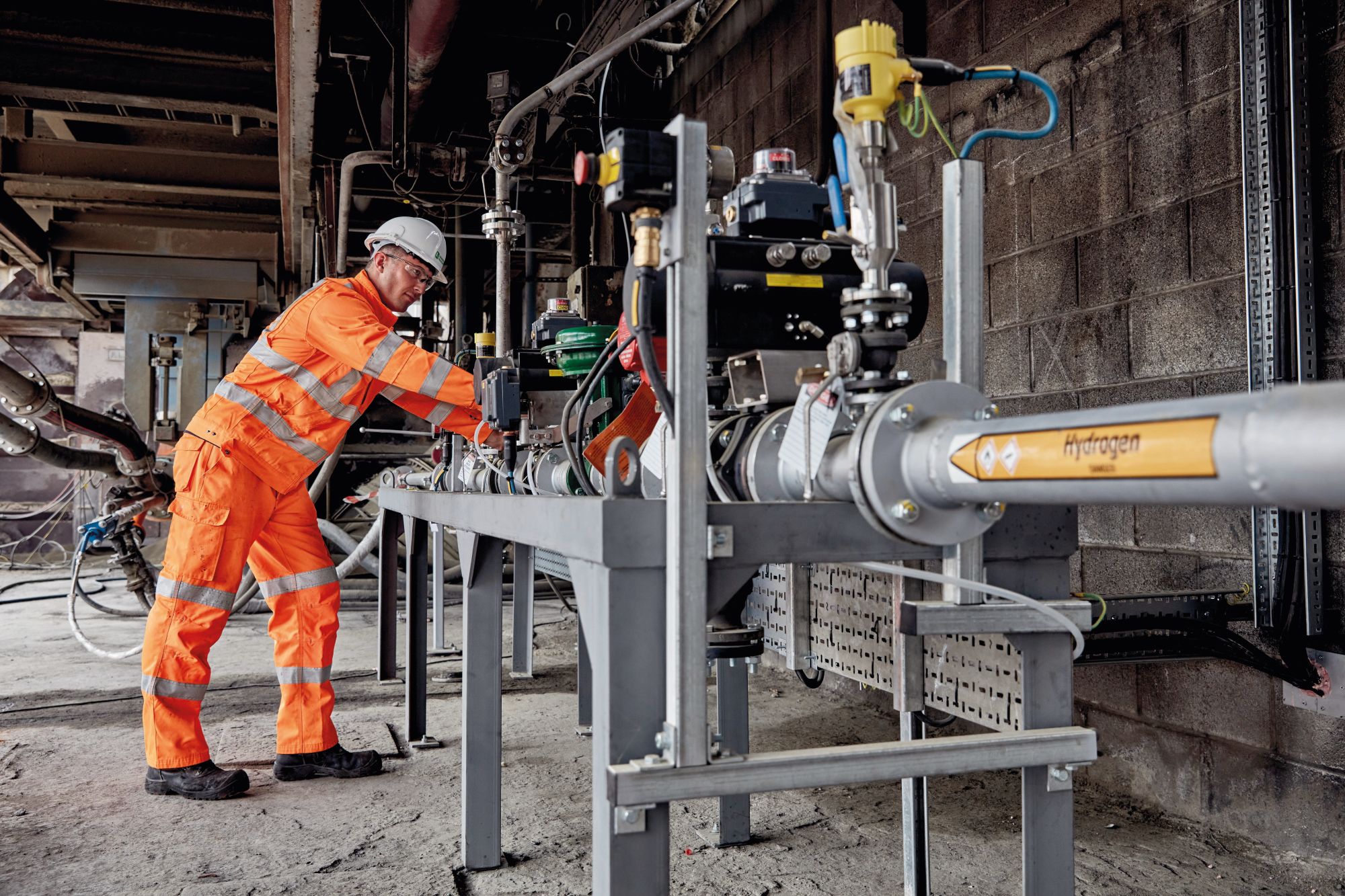
Hydrogen is one of the cleanest forms of energy available. A plentiful supply would present manufacturers with a viable fuel alternative, helping them survive and thrive.
If the British manufacturing sector wants to thrive — not just survive — it’s going to need hydrogen power, insists Dr Angela Needle, Director of Strategy at Cadent, the UK’s biggest gas distribution network.
Benefits of hydrogen
When burned, hydrogen doesn’t release carbon emissions, making it one of the cleanest forms of energy available and a vital element in the UK’s net zero strategy.1,2,3While it presents a huge decarbonisation opportunity for all gas users, it’s especially critical for energy-intensive industries such as glass and paper manufacturers and brick-makers.
“Hydrogen offers a way to balance the green energy system because, in a decarbonised world, we’ll need a renewable gas to generate electricity when it’s not windy or sunny,” explains Dr Needle. Also, she points out, some sort of renewable gas power will be essential for manufacturers, because their industrial processes — which run at very high temperatures — are neither technically feasible nor affordable to electrify. Hydrogen ticks that box.
At present, however, hydrogen isn’t widely used by UK manufacturers. “Industries thinking about decarbonising with hydrogen want to know that it’s a viable fuel alternative,” explains Dr Needle. “To do that, they need assurance that there’s a plentiful and cost-effective supply. So, it’s still early days.”
When burned, hydrogen doesn’t release carbon emissions, making it one of the cleanest forms of energy
The next steps for realising the potential of hydrogen
That said, things are changing. Currently, Cadent — which delivers gas to 11 million homes, businesses and 40,000 industrial customers — is actively developing hydrogen pipelines which support industrial decarbonisation. These include the HyNet project in the northwest and the H2 East Humber to Nottinghamshire Pipeline. Ultimately, the aim is that smaller regional networks will join up to create a secure, reliable and resilient national supply.
The Government, meanwhile, has developed a hydrogen strategy focusing on hydrogen use for industry and power generation, and is currently assessing the most suitable locations for pipelines. It has also produced a range of different subsidies to support hydrogen production. “We’re asking the Government to do with hydrogen what they did with renewable wind,” says Dr Needle. “That is, help get it established until it’s able to stand on its own.”
UK manufacturers certainly seem interested in hydrogen’s potential, with producers of paper, sugar, ceramics, glass and asphalt, among others, trialling it at their plants. “They’ve found that it’s compatible with their current processes and temperatures,” says Dr Needle. “Another benefit is that it’s a job creator. Making and delivering hydrogen creates jobs — and it also secures the future of manufacturers by enabling them to be globally competitive in a world where people want green goods.”
Case study:
Hydrogen is important for building materials manufacturer Heidelberg Materials UK due to its specific energy requirements. Cement kilns require a lot of heat (equivalent to 3,000 home boilers per hour). Meanwhile, producing asphalt, used in roads, runways and sports surfaces, has a fluctuating energy requirement, making electrification difficult.
In a world-first trial, the company successfully operated a cement kiln at its Ribblesdale works in Lancashire using a mix of 100% net zero fuels, including hydrogen. Now, it’s using hydrogen to decarbonise asphalt production at its Criggion plant in mid Wales. During the trial, hydrogen replaced liquid fossil fuels to produce more than 1,300 tonnes of asphalt, without impacting its quality or performance.
The project demonstrated hydrogen as a viable alternative to fossil fuels, achieving a 76% reduction in Scope 1 emissions and a 23% reduction in the overall carbon footprint of the asphalt produced.
According to Simon Willis, Heidelberg Materials UK CEO, “If we’re to reach our net zero ambitions, we need to consider carbon reduction measures across our operations. The success of these hydrogen projects demonstrates our leading position in trialling innovative solutions to enable the production of lower-carbon construction materials.”
[1] Environment Agency, Natural Resources Wales, Department of the Environment (Northern Ireland) & The Scottish Government. (2024). Hydrogen combustion: comply with emission limit values. GOV.UK. https://tinyurl. com/2bdmw8f6.
[2] UK Government. (2025). Carbon Budget and Growth Delivery Plan. https://tinyurl.com/24tj6dem.
[3] Department for Energy Security & Net Zero. (2025). Hydrogen Update to the Market. https://tinyurl.com/3zksz6fx.
